
We study why reforms fail to travel - and connect the people who tried with the people who want to try next.
For people between thirteen and thirty-five who intend to change something where they live, and for the practitioners who have already attempted it somewhere else.

Every year, thousands of young people encounter a story about somewhere that got something right. A city that gave its residents real budgetary power. A country that taught its teenagers to fact-check political claims. A ministry that published every meeting it held.
The story is inspiring. It is also incomplete. What almost never travels with it is the answer to the only question that matters: what had to already be true for this to work?
So the idea gets imported without its foundations - and quietly fails. Research on policy transfer is blunt about this: badly informed transfer is itself a cause of failure, not a neutral act.
There is a particular kind of adult who has read enough to know why every idea fails. Ask them about anything ambitious and you get the same answer: yes, but it's not that simple. They are usually right about the details and almost always wrong about what to do next, which is nothing.
We are not building that. We think it is one of the most destructive habits a person can acquire, and most people acquire it somewhere between twenty and thirty, quietly, without noticing.
So let's be exact about what we mean by learning from failure. There are two ways to react when you find out that something didn't work. The first is to conclude that it couldn't have. The second is to work out what would have had to be different. Only the second is useful, and the difference between them is not intelligence. It is whether you still want the thing.
Which is why we care about ambition first and evidence second. Read about a city that gave its residents real power over its budget and want that. Keep wanting it. Then find out what it actually rests on, and what happened to the people who tried it somewhere else without asking.
The reason we aim this at people between thirteen and thirty-five is that this is the window in which the habit forms. You are old enough to think seriously about how the world is arranged and young enough not to have decided yet that it can't be arranged differently. We would like you to arrive in the rooms where these things get decided still wanting something, and knowing why the last attempt failed.

Plenty of organisations collect examples of democratic and governance innovation. Very few tell you whether the example applies to you - and almost none tell you where it went wrong.
Every field has its hero stories. Almost nobody publishes the attempts that quietly stopped, and that is where most of the learning sits. We research those attempts independently and talk to the people involved, long after the fact. Nobody has to confess anything. They only have to teach.
Every case names the conditions that existed before the reform worked - the literacy levels, the institutional trust, the decades of civic history. Without these, the case is a story. With them, it is evidence.
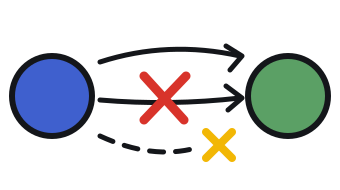
Each case names the conditions it depended on, so you can check them against your own situation, using established policy-transfer methodology.
Since 1976, NASA has run a channel for pilots and air traffic controllers to report what went wrong - on behalf of the regulator, but independent of it. Reports are voluntary, confidential and de-identified. Over two million have been filed, and it is one of the reasons flying became as safe as it is.
We are not a reporting system and we cannot offer anyone immunity. But the underlying insight holds: people share what went wrong when sharing costs them nothing, and what surfaces is worth more than any success story. Governance has no equivalent. That is the gap we work in.
Cases are organised by the problem someone is trying to solve, not by the country they came from.
Not everything has to be a national reform. Some of the most transferable cases operate at the scale of a single school, district or town - and those are often the ones a young person can actually start.
Research, preconditions, what went wrong, and an honest assessment of where it would and would not transfer.
Practitioners keep control: they approve what is published, and choose whether to appear by name, anonymously, or by institution only.
A young person with a concrete ambition is connected to someone who has attempted the same thing elsewhere. One person, chosen deliberately - not a directory.
Later: workshops and masterclasses on how to actually assess transfer - taught with researchers who study it, for people who intend to do it.

Thirteen to thirty-five. Not because that is when people have power, but because it is when they decide what they think is possible. From fourteen you are old enough to notice how things are arranged; by thirty-five most people have quietly concluded they cannot be arranged differently.
Senior people who implemented a reform - including the ones that did not work. Their most valuable knowledge is the part nobody publishes.
Case studies built to be taught, and a method for finding cases on whatever a group actually cares about. Workshops in person or online. For thirteen to eighteen.
The full case collection, an introduction to someone who has attempted what you are attempting, and help working out whether it would transfer. From eighteen.
Direct introductions begin at eighteen. Under eighteen we work through schools and organisations, never one to one.
 SDG 4
SDG 4Quality education - non-formal civic and governance learning built on evidence rather than inspiration.
 SDG 16
Peace, justice and strong institutions - better-informed institutional reform, and fewer imported failures.
 SDG 17
Partnerships - cross-border knowledge exchange between generations and between countries.
A first look at the case collection - what happened, what it took, and whether it would travel.
Two parts of the same state imported the same Brazilian model. One quietly wound it down. The other wrote it into law and hit its target in 2023.
Read the case →United Kingdom · Economy & entrepreneurshipOver 2,000 businesses, more than £1m in circulation, and international acclaim. It closed in 2021. Two systems built on the same idea are still running - one for 91 years.
Read the case →If you have attempted a reform that did not go as planned, if you are researching how policy travels, or if you are young and trying to build something where you live: we would like to hear from you.
Get in touchA single case of something that was tried, what it rested on, and what happened when someone copied it.